Archive for month: April, 2014

The Chinese in Early 20th Century Toronto: 29 Queen Street East – Chon Tai’s Laundry

Among the many names and establishments listed in Valerie Mah’s The Bachelor Society was Chon Tai, of 29 Queen Street East. According to the Goads Fire Insurance Plan Maps, the wooden building was constructed some time before the turn of the 20th century. The Toronto Tax Assessment Rolls indicate that it was a laundry service that predated Chon’s association: as early as 1897 it was staffed by and possibly lived in by Lee Ping, with Chon taking his place the following year. The laundry was part of a larger collection of neighbouring businesses, including a livery (a horse rental service) and a hotel, which were owned–leased to Chon–by the McCarron family.

Over the next 28 years Chon worked at the laundry service, through changes in ownership (from the McCarrons to the James & Bach Macdonald Supply Company; and later to Daniel Kenson and Alfred and Ruth Johnston) and directory assignment (29 Queen Street East was originally part of Division 1B within Toronto Ward 3. Between 1910 and 1911 the location was merged into Division 3 of the same Ward). The first two years, Chon spent all alone, living in his workplace. In 1901 he was joined by another Chon, unfortunately one without any first name listed in the Toronto City Directories. 1901 was also the year Chon Tai moved to 279 Church Street (which opened its own laundry service, possibly by him, in 1902), while the other Chon was stated to live at 177 McCaul Street. It’s possible that the two Chons were married or relatives; the unnamed Chon might have been a relative who immigrated to Canada in 1901. The second laundry service at 279 Church could indicate either Chon opening his own service or getting a second job to make ends meet, which would make sense given the presence of someone other than himself to support. Valerie Mah listed two other Chinese immigrants with Chon Tai, but only the one, unnamed Chon is listed in the city’s records.

Between 1926 and 1927 Chon Tai passed on the lease to a new owner, Tong Chui. The laundry business continued until 1946, when it was demolished and replaced with a parking station. Such became the lot’s purpose until the present day, for it is now part of a multi-level parking garage owned by the Toronto Parking Authority.


Sources

Toronto Tax Assessment Rolls: Ward 3 Division 1B. 1898-1910. Toronto Archives. Microform.

Toronto Tax Assessment Rolls: Ward 3 Division 3. 1911-1946. Toronto Archives. Microform.

Toronto City Directory. 1899-1901. Toronto Archives. Microform.

Goads Fire Insurance Plan (1899, 1913). Web. Obtained 04/08/2014 from http://www1.toronto.ca/wps/portal/contentonly?vgnextoid=b1ab757ae6b31410VgnVCM10000071d60f89RCRD&vgnextfmt=default

Mah, Valerie.  The Bachelor Society: A Look at Toronto’s Early Chinese Community from 1878 – 1924 (unpublished, 1978).

The Chinese in Early 20th Century Toronto: 420 1/2 Yonge Street

According to Valerie Mah’s paper, The ‘Bachelor’ Society, a Chinese individual was identified as being connected to 420 1/2 Yonge Street in July 1900.  Bert Lee ran a laundromat at that address in the early 1900s, but today, that address no longer exists.

The Chinese in Early 20th Century Toronto: 926 Bloor Street West

This laundry was located at 926 Bloor Street West.  This laundry was found during the years 1889 to 1905. The laundry did not change its name or location during that time and it was also found during this research that two people named Ling and Sam were also mentioned to be working there. Also beside there names was another address mentioned for 206 Queen Street which would assumed to be the place where they lived.

The Chinese in Early 20th Century Toronto: 158 Bay Street – Kwong Yoot Loy Co.

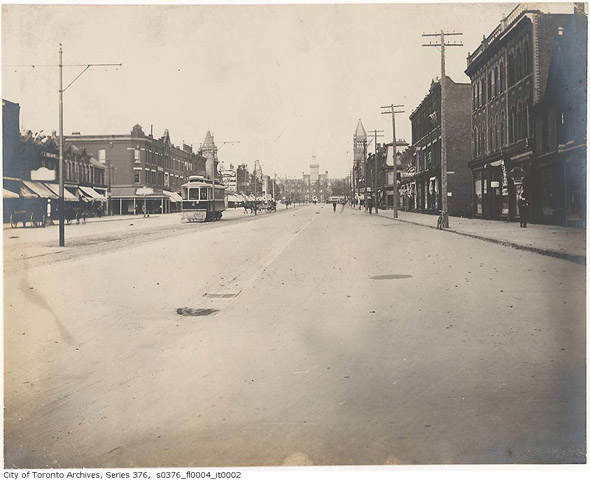
158 Bay Street in 1907 - Small building on the lefthand side

158 Bay Street in 1907 – Small building on the lefthand side

According to the 1899 City of Toronto Directory, 158 Bay Street was owned by a man named Jones W H and the building functioned as a restaurant. However, in the following year, 1900, the directory marked the same building as vacant. In 1901, 158 Bay Street came under the ownership of a man named Yee Nam who also ran a restaurant in the same building. The restaurant according to the 1901 City of Toronto Directory was named Kwong Yoot Loy Co. This information corresponds to Valerie Mah’s independent research paper titled, The Bachelor Society. A letter from Rev. Mackay of the United Church recorded that 3 adults of Chinese “religion” lived at this address. From what is known about the history of Chinese immigrants and considering that no children were recorded living in the building, the most likely conclusion is that these residents were Chinese bachelors who came to Canada to make a living.

Chinese residency at 158 Bay Street did not seem to be a long one according to the 1902 City of Toronto Directory. In the year after the Kwong Yoot Loy Co.’s inclusion in the directory, it states that a few barristers and artists took up residence where Kwong Yoot Loy Co. once stood. Of all the names included, none are of Chinese origin. This leads one to believe that the restaurant failed to succeed and therefore closed in favor of business and residential space.

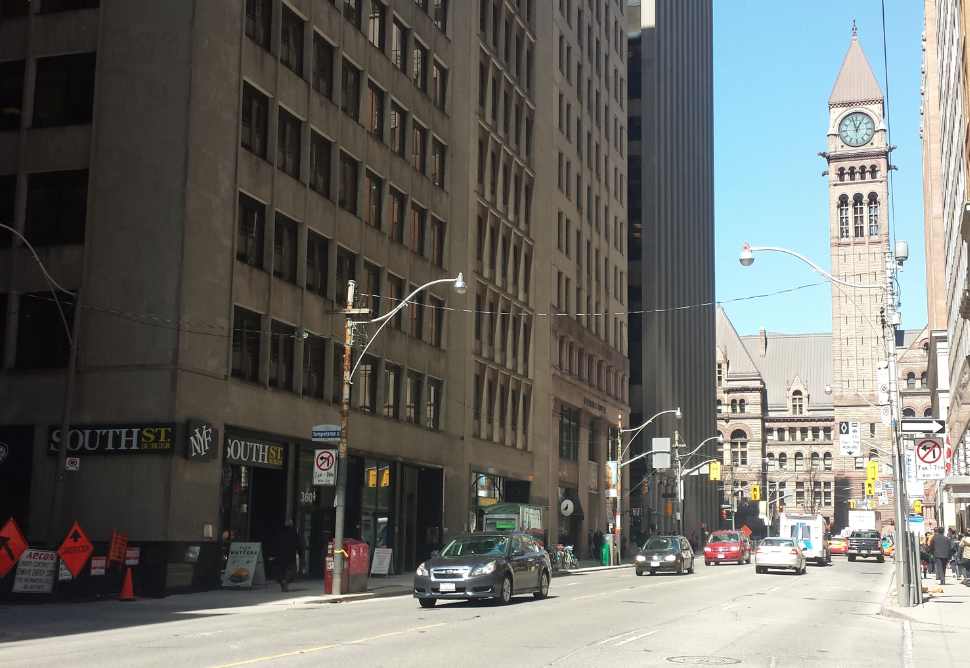
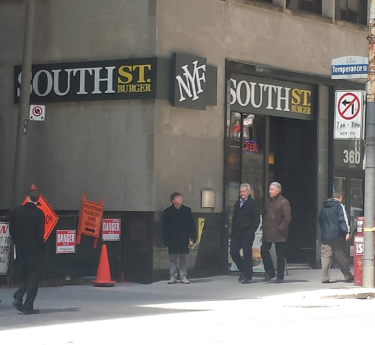
360 Bay Street taken from the southeast corner of Bay and Temperance - April 9 2014

360 Bay Street taken from the southeast corner of Bay and Temperance – April 9 2014

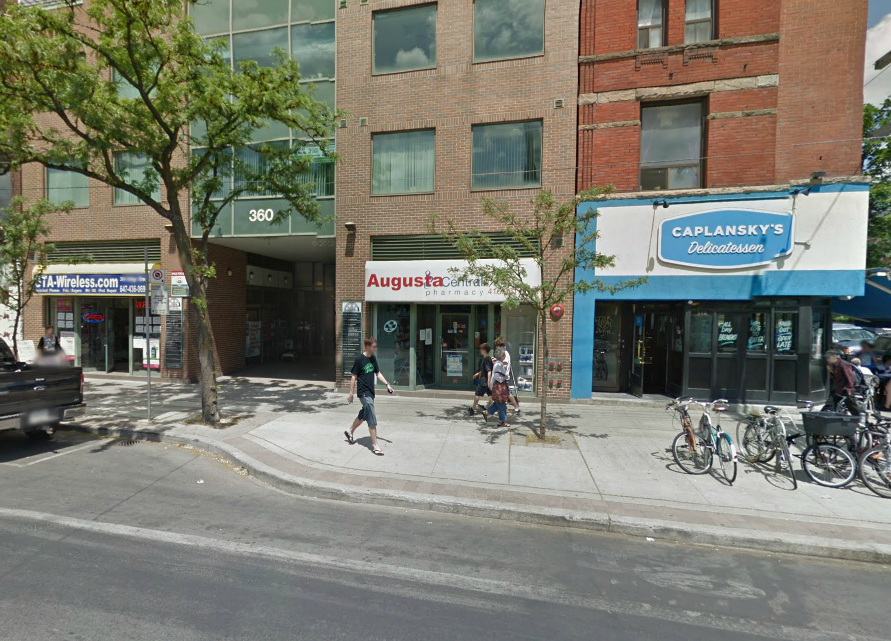
Currently, what once was 158 Bay Street is now a part of 360 Bay Street. On the Corner of Bay and Temperance Street where a restaurant once stood at the turn of the century is now a fast food restaurant called New York Fries/South St. Burger. The address change can most likely be attributed to the expansion of the Toronto harbourfront, causing the addresses to be shifted.

360 Bay Street 2

360 Bay Street taken from the southeast corner facing north on Bay and Temperance – April 9, 2014


Works Cited

“Bay Street Looking North from Temperance Street.” 1907. City of Toronto Archives, Fonds 1244, Item 43. Web. 7 April 2014.

Mah, Valerie. The bachelor society: a look at Toronto’s early Chinese community from 1878-1924. MA Thesis. 1978. Print.

The City of Toronto Directory. 1899. Microform. City of Toronto Archives. Location no. 264730-45, Reel 45.

The City of Toronto Directory. 1900. Microform. City of Toronto Archives. Location no. 264730-46, Reel 46.

The City of Toronto Directory. 1901. Microform. City of Toronto Archives. Location no. 264730-47, Reel 47.

The City of Toronto Directory. 1902. Microform. City of Toronto Archives. Location no. 264730-48, Reel 48.

“Ward 2 Division 2 (p 196) to Ward 3 Division 2 (p110).” The City of Toronto Assessment Rolls. 1901. Microform. City of Toronto Archives. Location no. 264736-39, Reel 147.


The Chinese in Early 20th Century Toronto: 153 Church Street, Toronto

153 Church Street appears on the Goad’s insurance map dating back to 1880 when it was the last address on Church Street before Shuter. However, more addresses were added to the map in 1890 and 153 Church Street became 151-3, suggesting that the building was split to allow for more tenants. That the building had multiple tenants is evidenced in the City of Toronto Directory, as in 1899 153 Church Street was not only occupied by a Chinese Laundry run by Lew Mokee, but also listed as occupants of the residence were Wm Brown and Mrs. Melinda Taylor. Listed on the assessment rolls for the same year, the only name that appears is that of Lew Mokee who leased the building from someone named Gilmore. However, this changed in 1900, as the building was then owned by A. Welles and was still occupied by a Chinese Laundry, but the laundry was run by Sam Hing. Also listed as tenants of the building in the City of Toronto Directory for 1900 were Wm Allen, Michal Mcnab, and Mrs. Melinda Taylor, none of whom are listed in the Assessment Rolls for the same year. In 2014, the site of 151-3 Church Street has become “The Gold Lobby” and “The Fire Star Exchange,” both of which are jewellery trading businesses.


Works Citedd

Assessment Roll: Ward 3 Division 2 1900 (1899 for tax year 1900). Toronto Archives.

Assessment Roll: Ward 3 Division 2 1901 (1900 for tax year 1901). Toronto Archives.

Toronto Directory (1899, 1900). Toronto Archives. Goads Fire Insurance Plan (1880, 1890, 1899, 1903). Toronto Archives.

Google Maps, 2014. https://maps.google.ca/maps?ie=UTF-8&layer=c&z=17&iwloc=A&sll=43.653833,-79.376002&cbp=13,90.2,0,0,0&cbll=43.653833,-79.376020&q=r+153+church+street+toronto+ontario&ei=ylRIU7HZJqTN2AXTzYDgCA&ved=0CCoQxB0wAA

The Chinese in Early 20th Century Toronto: 358 College Street c. 1899

Based on Valerie Ma’s information and verified using records from the Toronto Archives, Gum Chong moved into 385 College Street in 1899 and established a laundromat.  Prior to this, the lot varied between an empty space and a church. According to the City of Toronto Assessment files from 1901, Chong was still occupying the space a few years later with four other residents. It can be assumed that these residents were at the least, over the age of 18 as none of these residents were listed as children. Unfortunately, Gum Chong and his laundromat only lasted a few years. By 1913, the building was then occupied by jeweler F.A. Ellis.


2012425-spadina-north-to-college-1890s-s0376_fl0004_it0002

This picture was taken on Spadina facing north to College, c. 1890s.


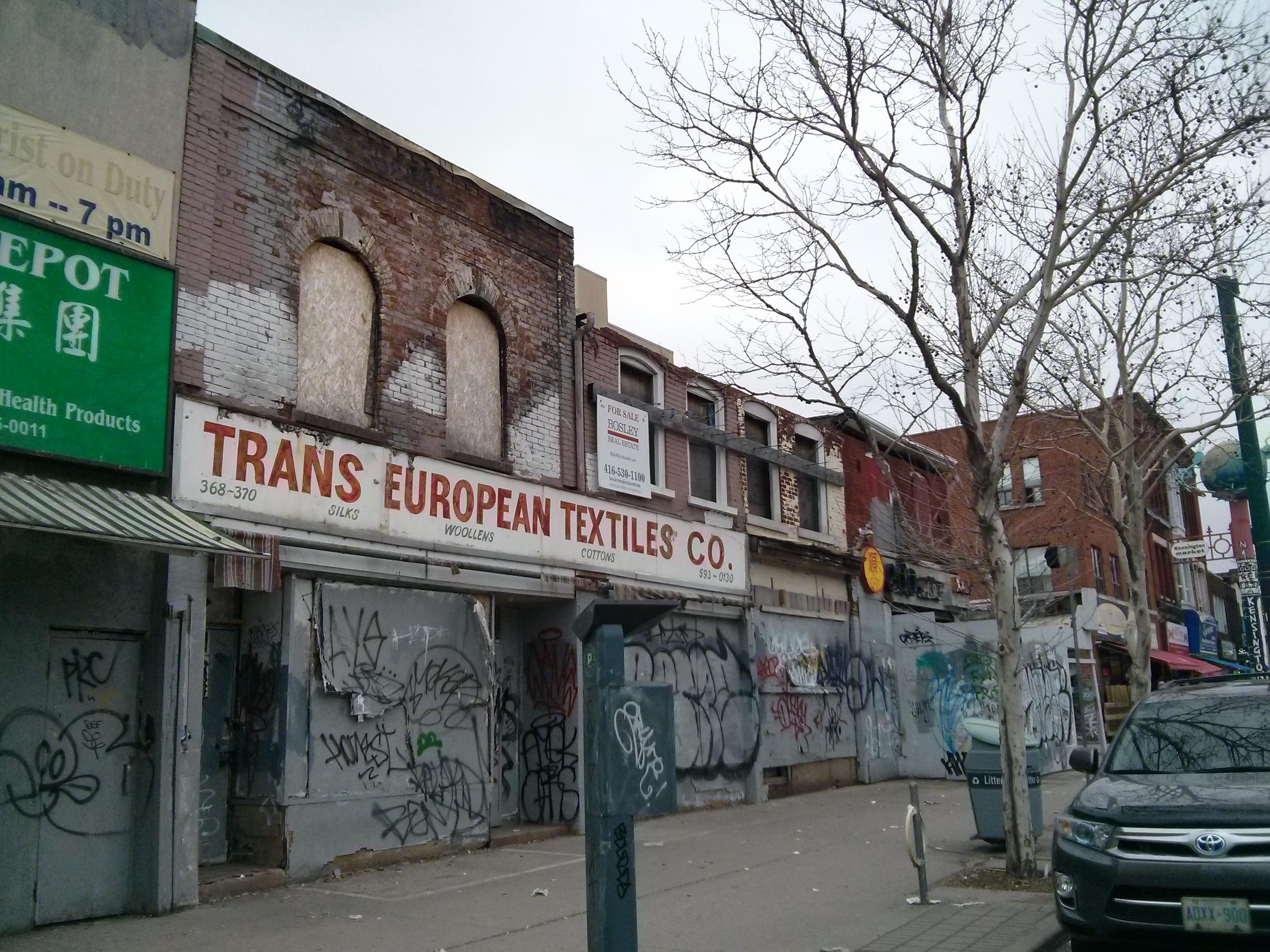
This is the building as it stands today, 2014. It is now a commercial and office space located in the now Kensington Market neighbourhood.


Information and Sources taken from City of Toronto. Tax Assessment Rolls. Ward 4 Division 3 (1901). City of Toronto. Directories (1895-1899, 1901).  Mah, Valerie. The Bachelor Society: A Look at Toronto’s Early Chinese Community from 1878-1924. MA Thesis. 1978. Print.

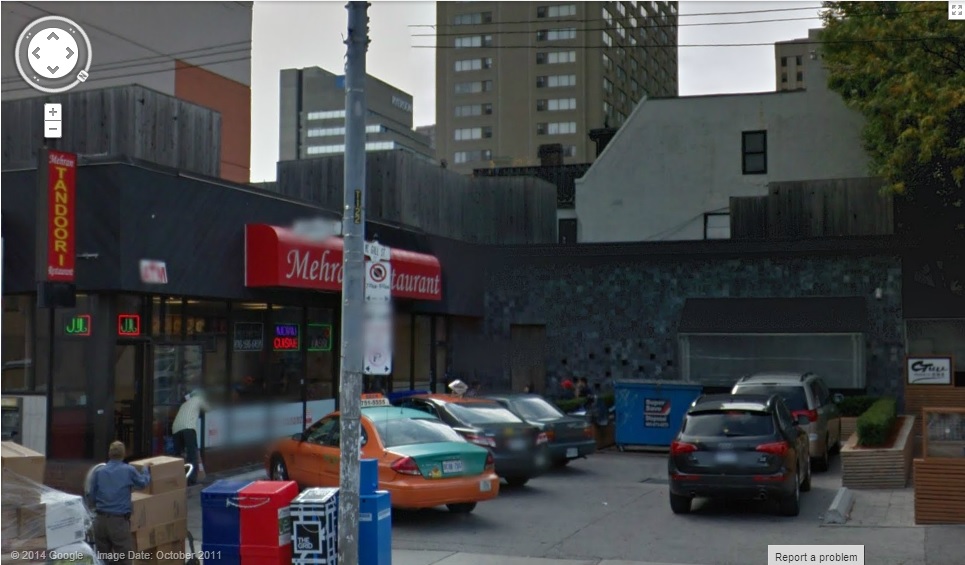
372 Spadina Today

The Chinese in Early 20th Century Toronto: 372 Spadina Avenue – Mark Lum

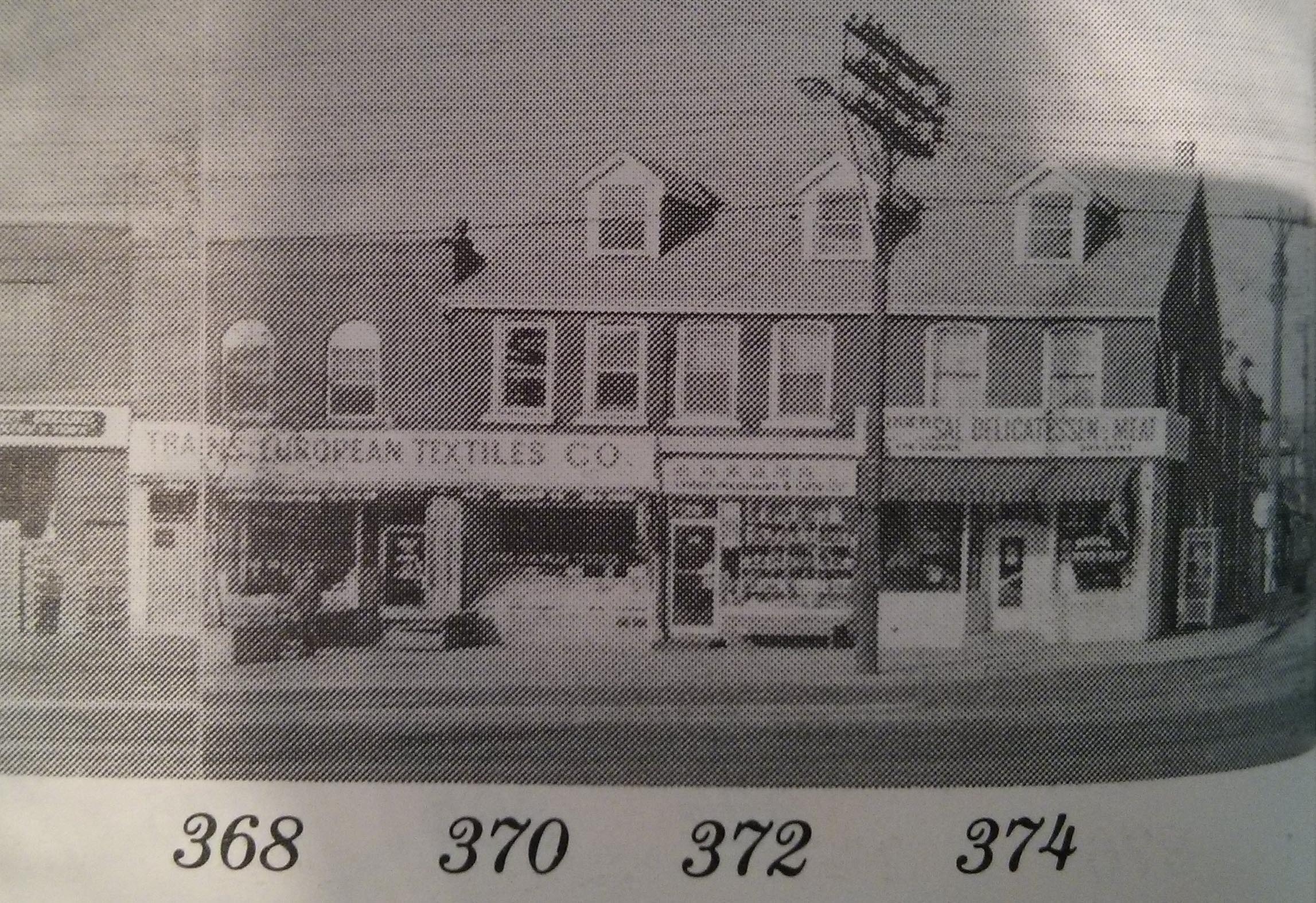
Mark Lum didn’t occupy 372 Spadina Avenue until 1901. In 1899, John Law owned an entire block of wood commercial space, with residential space above, from 370 to 382 Spadina Avenue and lived in 372 himself. In 1901, John Law rented out 372 to Mark Lum. Lum lived with three other adults in the apartment above and operated a Chinese laundromat  below. Just a year later, in 1902, Lum disappeared from the assessment rolls but 372 Spadina continued as a Chinese laundromat under Juong Yoong. Yoong lived above with two other adults under this record instead of three the previous year. This suggests that Lum either died or left his laundromat to Yoong and moved out a year after opening it.

Only a year after Yoong took over, 372 Spadina was exempt from the assessment roll. This means that a laundry service was no longer in operation and the building was empty.

Years later the property was sold to Alfred G. Brown who operated a barber and cigar shop at 372 and the neighbouring space next door.


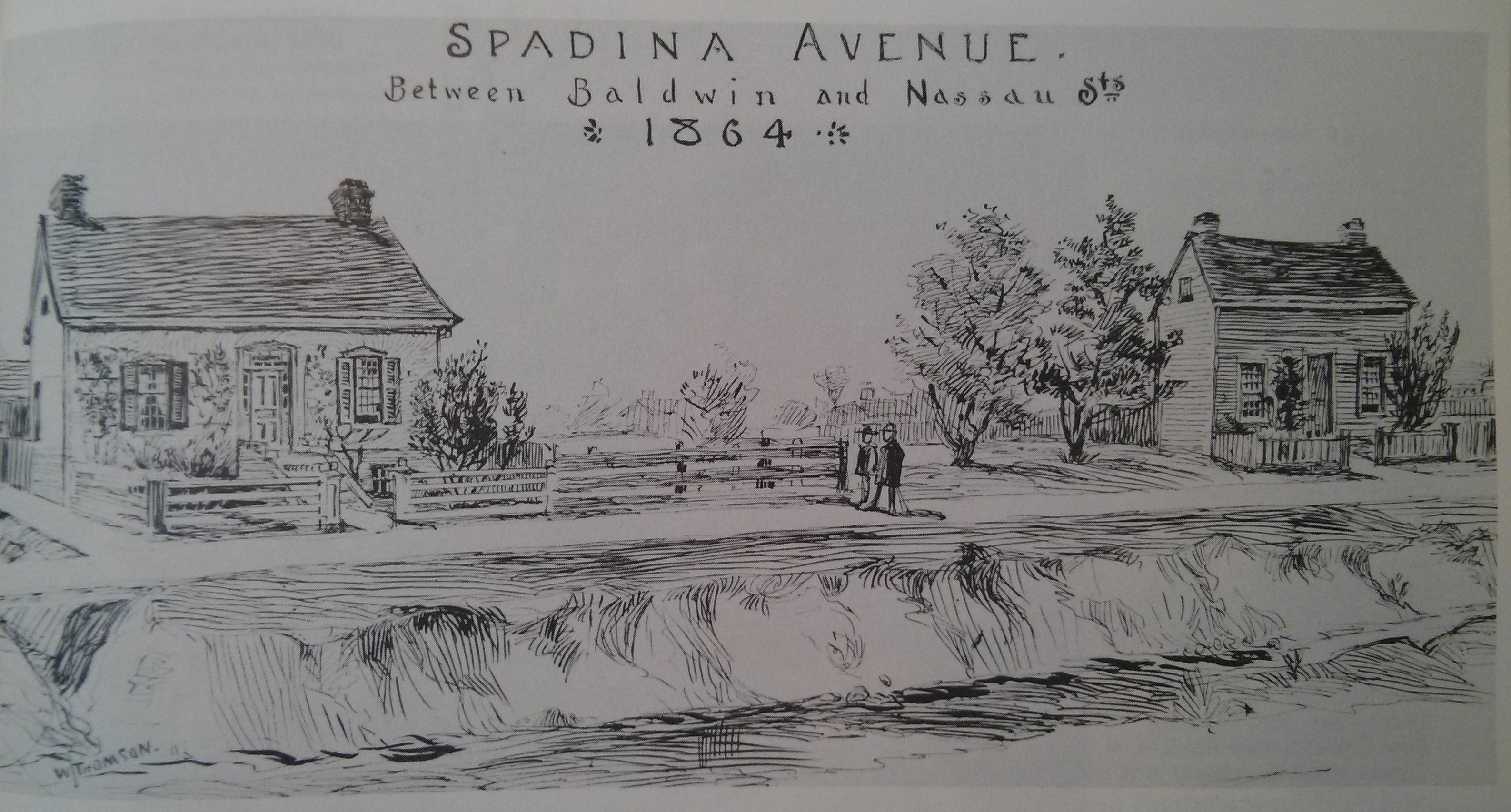
This is what the block, where Mark Lum's Laundry was situated, would have looked like 60 years before he started.

This is what the block, where Mark Lum’s Laundry was situated, would have looked like 37 years before he started.

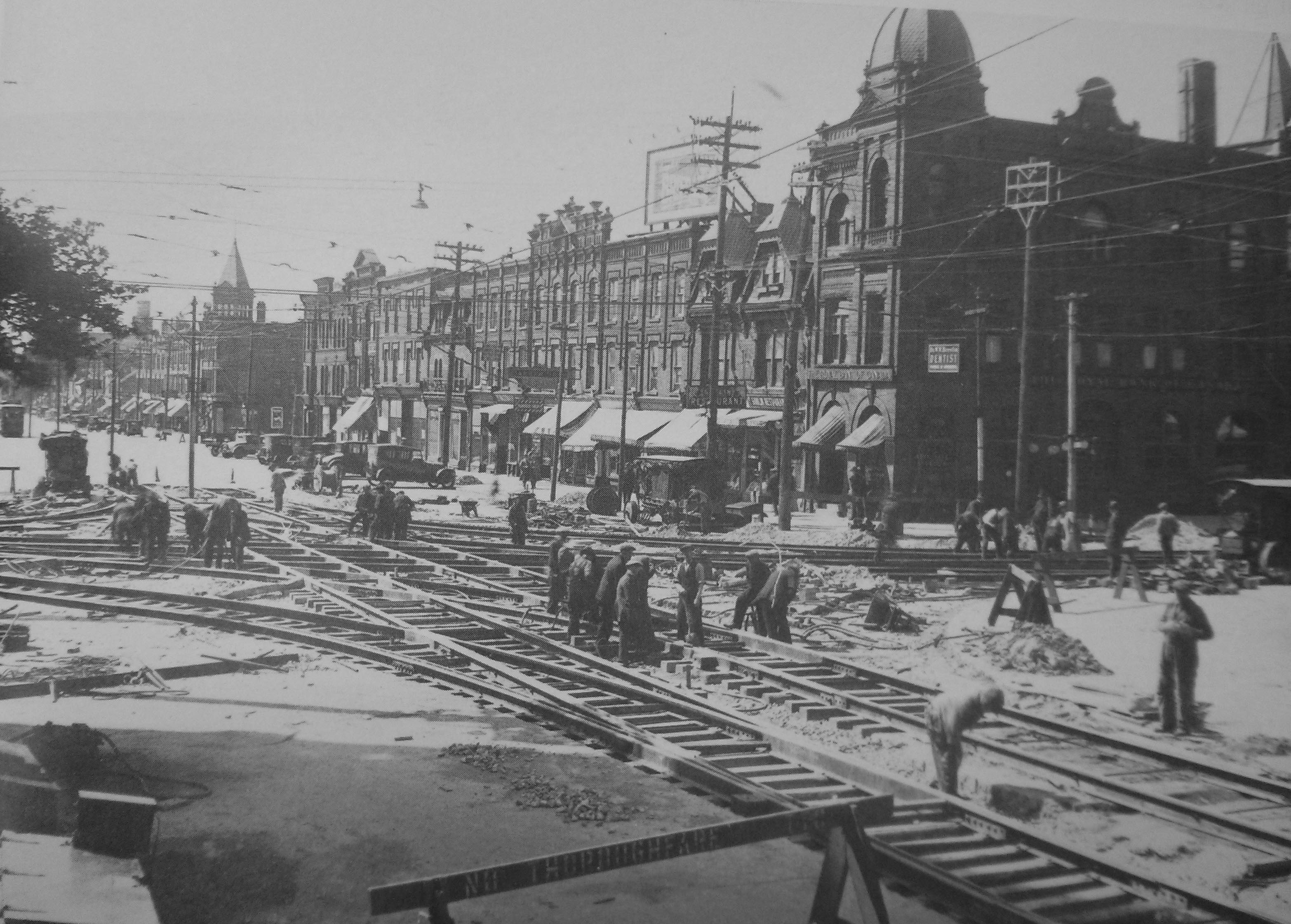
Reconstruction of Spadina and College in 1941 --Lum's  Laundry is just one block south from this photo --

Reconstruction of Spadina and College in 1927 –Lum’s Laundry is just one block south from this photo —

372 Spadina in the 70's

372 Spadina in the 70’s

372 Spadina in the 90s

372 Spadina in the 90’s

Works Cited

Assessment Roll: Ward 4 Division 2 1899

Assessment Roll: Ward 4 Division 2 1901

Assessment Roll: Ward 4 Division 2 1902

Assessment Roll: Ward 4 Division 2 1903

Assessment Roll: Ward 4 Division 2 1909

Assessment Roll: Ward 4 Division 2 1912

Northwest Corner of Spadina Avenue and Baldwin Street. October, 1973. City of Toronto Archives, Toronto. Print.

Panorama of Spadina Avenue. 1985. Spadina Avenue by Rosemary Donegan. Vancouver: Douglas & McIntyre. Print

Thomson, W.J. Spadina, Baldwin and Nassau. 1896. Metro Reference Library. Spadina Avenue by Rosemary Donegan. Vancouver: Douglas & McIntyre. Print

Toronto Transit Commission. Re-Laying Streetcar Tracks. 1927. Spadina Avenue by Rosemary Donegan. Vancouver: Douglas & McIntyre. Print


The Chinese in Early 20th Century Toronto: 834 King Street West

Valerie Mah’s The ‘Bachelor’ Society indicates that in 1900 a Chinese resident was at 834 King Street West. My research found that in the City of Toronto Directory for 1901, a different person than Sam Lee lived at the address. It was Davis Mrs M, gro Davis Wm.  Where this establishment was supposed to exist is now an intersection at King St and Niagara St.


The Chinese in Early 20th Century Toronto: 396 Church Street – Sui Wah’s Laundry

City of Toronto Archives, Series 372 s0372_ss0033_it0367

390-396 Church Street 1938


Google Maps 2011

390-396 Church Street 2011


Sui Wah resided at 396 Church Street starting from 1895, when, at that time, the establishment, a laundry, was named after him. In 1904 the laundry changed names to the “Chong Hong, laundry.” A neighbouring building in the 1930’s eventually became the W. York laundromat, but was most likely not Chinese owned. Other spellings in various directories include “Wah-Sui”, “Sul Wah” and “Sin Wah”. At the time religion was also recorded in the tax assessment, and as opposed to Roman Catholic or Church of England designations, his faith was labelled as “Chinese”.

Sui Wah lived alone under landlord Petros Constantinide. During his tenancy the value of the property decreased significantly by several hundred dollars, which may be caused by decreasing the size of the lot artificially.


Works Cited

City of Toronto. Tax Assessment RollsWard 3 Division 2 (1894). Reel 103, Location 264736:73.

City of Toronto. Tax Assessment RollsWard 3 Division 2 (1901). Reel 147, Location 264736:39. Microfilm. Pg. 27.

City of Toronto. Directories (1894). Reel 39.

City of Toronto. Directories (1895). Reel 40.

City of Toronto. Directories (1899). Reel 44. Microfilm. Pg. 119.

City of Toronto. Directories (1900). Reel 46. Microfilm. Pg. 116.

City of Toronto. Directories (1901). Reel 47. Microfilm. Pg. 114.

City of Toronto. Directories (1904). Reel 50. Microfilm. Pg. 125.

1938. Dept. of Public Works Photographs, Toronto. 390-396 Church Street. Fonds 200, Ser. 372, Subser. 33, Item 367. City of Toronto Archives. Web. 10 Apr. 2014.

“390 Church Street, Toronto, ON.” Google Maps. Web. 11 Apr. 2014.

The Chinese in Early 20th Century Toronto: 337 Bathurst Street

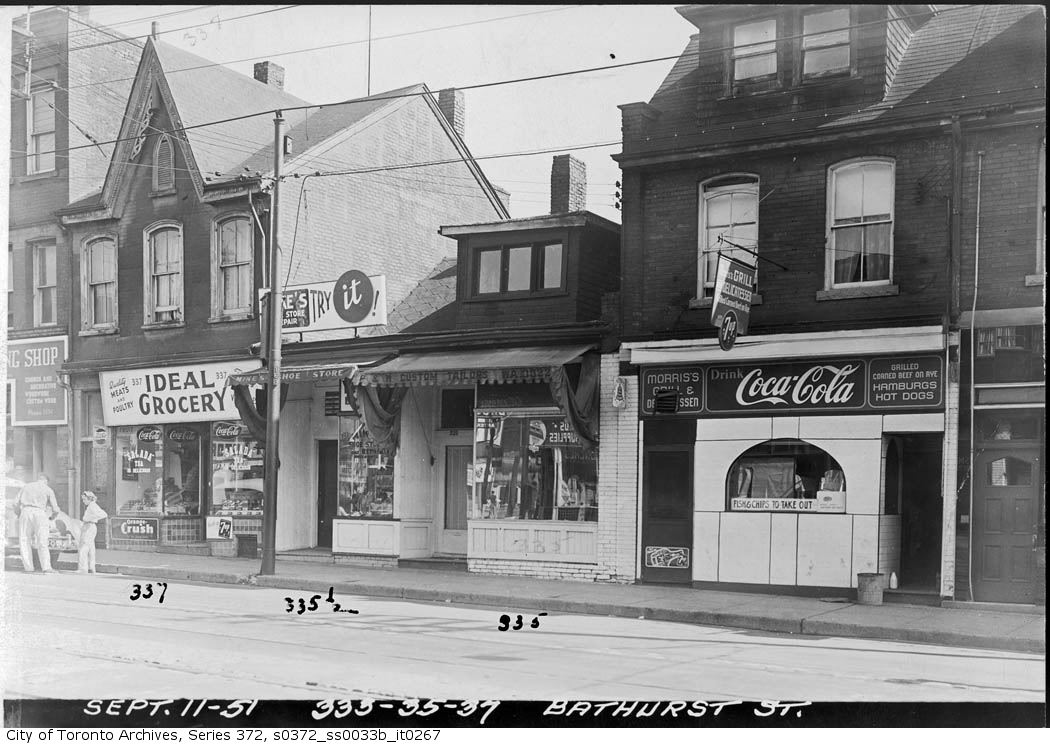
According to the research conducted by Valerie Mah and the records found within the City Directory of the Toronto Archives, Mr. Gee Lee became a tenant of 337 Bathurst Street in 1900. Within the wood building lived two residents. Mr. Lee ran a laundry in the downstairs space of 337 Bathurst Street, while a Mr. James Thompson lived upstairs. The 18 x 145 square foot laundry is kept under Mr. Lee’s name until 1913, for in that year the City Directory simply states 337 Bathurst Street is a Chinese Laundry. As of 1913 on, it is unclear if Mr. Lee still lives there or if the laundry was taken over by someone else.


1950 Bathurst Street

This is 337 Bathurst Street in 1951. Photo is taken from the Toronto Archives


In the Toronto Archives, the city Fire Insurance Plans reveal that from 1899-1924, this address remains the same and the building is still made of wood. Both 335 and 337 Bathurst Street are owned by the Lawson sisters, Caroline and Mary. Both sisters are single and of Catholic faith. In 1902, Mary Lawson is living in the apartment above, while Mr. Lee is still operating the laundry. 335 Bathurst Street is rented to Mr. William Clean, a belt maker. The house has three residents, and according to The City Assessment Roll of 1902, all are of Catholic faith. The neighbourhood appears to be inhabited by the working class. The City Assessment Roll of 1902 reveals the occupation of the residents, they are as follows; book keeper, clerk, belt maker, laundry owner and shoe maker. Skipping ahead a few years to 1951, 337 Bathurst Street is still an active address and now a grocery store. Today this address is currently part of a park.


IMAG0212

337 Bathurst Street 2014.


Works Cited

City Fire Insurance Plan (1899, 1903, 1913, 1924); Toronto Archives Website

City of Toronto Assessment Roll: Ward 4 Division 2 1902 (1901 for tax year 1902), Reel 155, Toronto Archives

City of Toronto Directory: Year, 1899, 1900, 1902, 1906, 1913; Toronto Archives

Mah, Valerie. The Bachelor Society: a look at Toronto’s early Chinese community from 1878-1924. MA Thesis. 1978. Print.