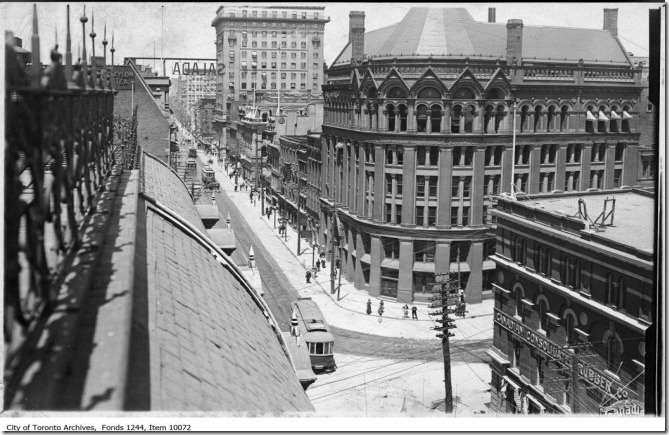
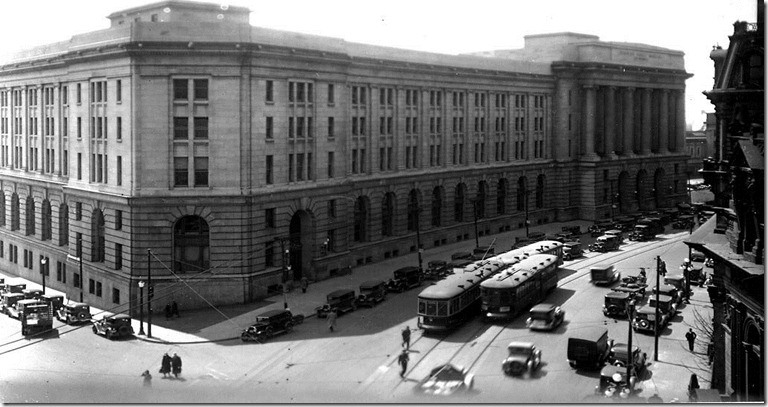
According to the book called The Chinese in Toronto from 1878 by Arlene Chan, in 1902 this address was operated as a Chinese Tea shop along with other tea shops such as Lee Chong Yung at 154 York street, Yee Quong Teas at 1561/2York Street, and Kwon Yong Loy at 85-87 Queen Street East. This tea shop was owned and operated by Quong Ying Yune. It was part of Toronto’s first Chinatown back (1878-1960). Currently, the Thompson Building in the Sheraton Centre is on the location of the former tea shop.
References:
1. Chan, Arlene. The Chinese in Toronto from 1878: from outside to inside the circle. Toronto: Dundurn Press, 2011. Print.
2. Qiu, Paul . “Changes to Toronto’s Chinatown: Toronto’s First Chinatown and Downtown Chinatown | CCNC Toronto Chapter.” Chinese Canadian National Council Chapter . N.p., n.d. Web. 11 Apr. 2014. .
/wp-content/uploads/2013/04/countercultureslogopart3-300x106.png00hayi/wp-content/uploads/2013/04/countercultureslogopart3-300x106.pnghayi2014-04-14 18:10:012014-04-22 18:32:17The Chinese in Early 20th Century Toronto: 69 1/2 Queen Street West
In a July 1900 letter to Rev. Mackay noted in Valerie’s Mah’s Bachelor Society , 175 St. Patrick Street was an address associated with early Chinese immigrants to the city of Toronto. 175 St. Patrick Street was located at the intersection of what is now Dundas Street West and Kensington Road. In 1899, according to tax documents, eight people were residing in this brick residence, three of them children, suggesting it to be a residence for multiple people, possibly immigrants. It was owned by Robert Crates, but the main tenant was Robert McLelland. It is possible that some of the other residents may have been Chinese since the location was relatively close to where old Chinatown used to be. In 1901 the ownership of the building changed hands. Robert McLelland became not only the tenant but the taxable owner as well of the building. The number of residents did not change. This building has since been torn down and is now part of a public housing complex only a block away from the heart of Chinatown at Spadina St. and Dundas St. W.
Works Cited
Assessment Roll: Ward 4 Division 1 1899, Toronto Archives.
Assessment Roll: Ward 4 Division 1 1900, Toronto Archives.
Assessment Roll: Ward 4 Division 1 1901 Toronto Archives.
Goads Fire Insurance Plan: Central Toronto (1899); Toronto Archives Website
Goads Fire Insurance Plan: Central Toronto (1924); Toronto Archives Website
/wp-content/uploads/2013/04/countercultureslogopart3-300x106.png00Daniel Gomez-Ortega/wp-content/uploads/2013/04/countercultureslogopart3-300x106.pngDaniel Gomez-Ortega2014-04-14 18:07:592014-04-14 21:40:50The Chinese in Early 20th Century Toronto: 175 St. Patrick St. (1899) (now 567 Dundas St. W.)
Based on the information obtained about this address from the City of Toronto Archives/City Directory, in 1900, 133 Argyle was owned by James and Heffer, however the tenant was Charlie Louie. When Louie was at this address, according to the Toronto Assessment Rolls, he was conducting a laundry business. The Assessment Rolls also indicate that Louie was identified as a 41 year old Christian man and was the only person living at the address. He had no family members with him. Twenty years later (1920), Charlie was still doing the laundry business at this address.
The images below shows Argyle Street in the early 20th century.
/wp-content/uploads/2013/04/countercultureslogopart3-300x106.png00hayi/wp-content/uploads/2013/04/countercultureslogopart3-300x106.pnghayi2014-04-14 17:57:192014-04-22 18:35:41The Chinese in Early 20th Century Toronto: 133 Argyle
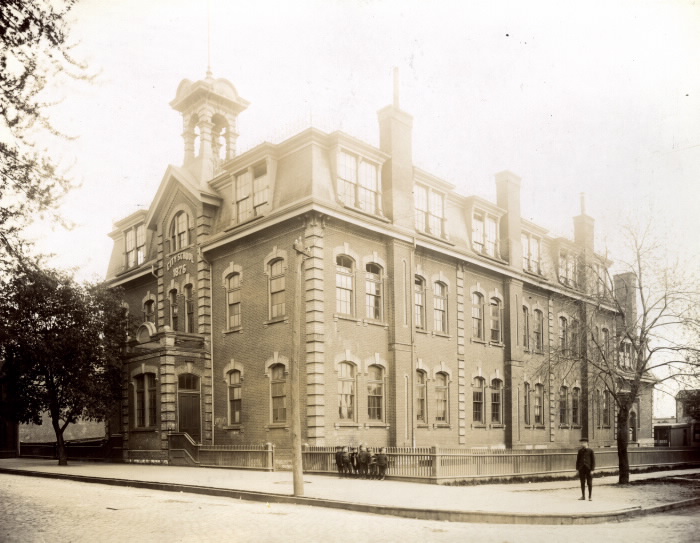
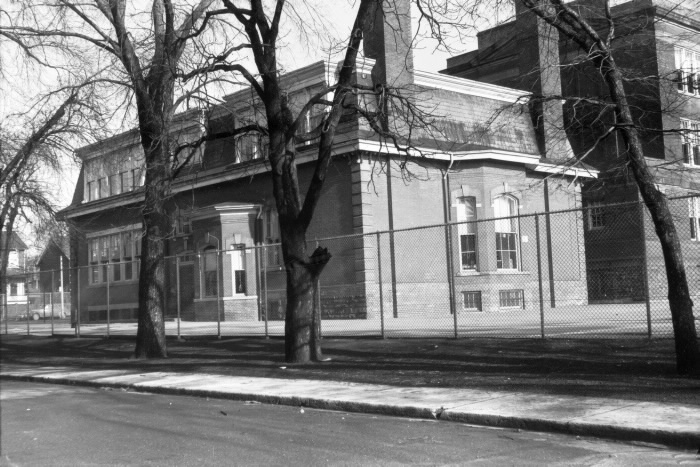
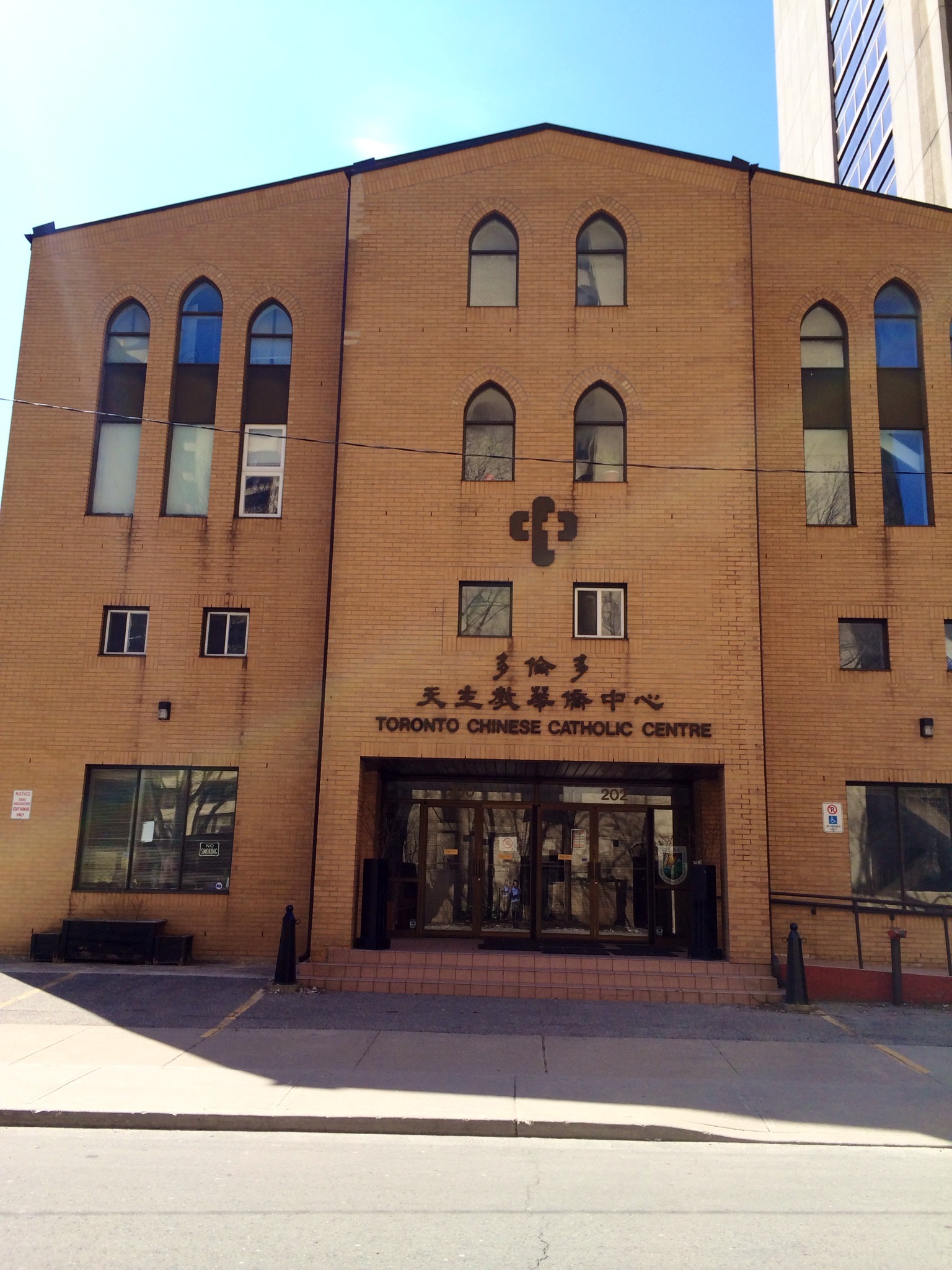
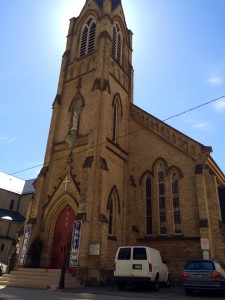
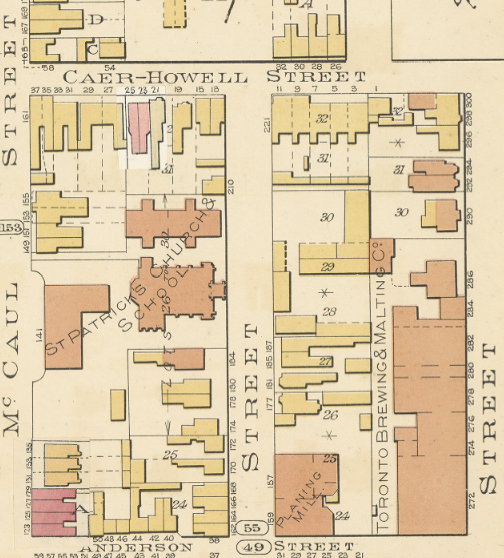
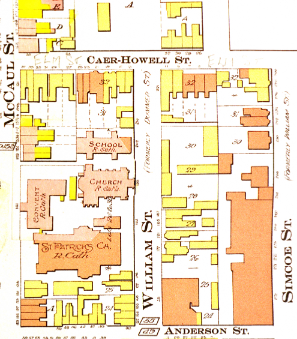
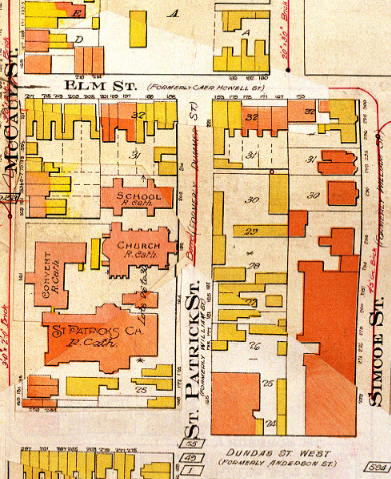
202 St. Patrick Street in Toronto, Ontario is currently a community centre for those of Chinese heritage. The Toronto Chinese Catholic Centre is connected to a Chinese Roman Catholic Church entitled “Our Lady of Mount Carmel Church”. However, 202 St. Patrick Street was not always a community centre. Through the assistance of the City of Toronto Archives, I was able to conclude that the location was actually a Roman Catholic school in the early 1900s. In fact, the location was not even known as “202 St. Patrick Street”. Pre-1900s to 1920’s, the street St Patrick was called Williams Street and the lot number was 208. William Street intersected with Caer-Howell Street (now Elm Street) and Anderson Street (now Dundas St. West). The name of the school is referenced in the maps as “St. Patrick’s School”, however, in other records, the name is disclosed.
Even in the early 1900s, the school (along with other prominent establishments, like the “Planning Mill”) was one of the few brick-built structures in the area. Most houses near the school were wooden . The school and church were able to build an additional cathedral beside “Our Lady of Mount Carmel” by the year 1913, the reason is unknown. By 1913, the school was now considered as lot 202 but the street name was still Williams Street.
1989
1913
1924
Assessment Role Findings
202 St. Patrick Street was classified as “separate school” in the 1901 Assessment Roles. This is important because it was not considered a public establishment, thus the taxation rate was paid differently. The owner name is indicated by 1914. “J. Hall” who lives at 28 Duke Street was considered the owner of the school at the time. As the 1922 Assessment Role indicates, “J. G. Hall” seems to keep the building through the 1920’s as well.
The size of the lot was 79×126 meters. This lot size remains unchanged from 1901 through 1922 showing a lack of additions made to school over the years. Another indication that the building was not added to is the “Value of the Building”. The “Value of the Building” remains at $4000 throughout the years 1901 through 1922. However, the “Value of Land” began to increase substantially. The land cost grew from $3160 in 1901 to $8690 in 1913.
The number of tenants is always listed as “X” indicating there is nobody who was living at 202 St. Patrick Street at any point of its establishment. Another (rather obvious) side note is that the school is labelled “Exempt” when mentioning livestock or crop production.
/wp-content/uploads/2013/04/countercultureslogopart3-300x106.png00Matteo Cianfrone/wp-content/uploads/2013/04/countercultureslogopart3-300x106.pngMatteo Cianfrone2014-04-14 17:53:322014-04-14 21:42:21The Chinese in Early 20th Century Toronto: 202 St. Patrick Street
According to the city of Toronto directories, 636 Yonge Street, was non-existent in 1880 and in 1900. However, in the 1920 City Directories, the address appeared, as did the name of tenant. Based on the city directories, at this address a Chinese Laundry business was being operated by Sam Wo, the tenant of the address at the time. More information on this address was not found on the City Assessment Rolls of 1920, but it was found for 10 years later (1930). In 1930, this address was still being operated as a Chinese laundry by Sam Wo, who at the time, was 52 years of age. The owner of the address at the time was ‘Mcwhimmery William’. On the assessment rolls it showed that Sam Wo’s religion was identified as ‘Chin’.
There were no specific old pictures found of this address, however, the uploaded pictures here just show how yonge st looked like in 1912 and in 1934. These pictures were taken online from ‘Toronto’s amazing intersection at Yonge and Front Streets’: http://tayloronhistory.com/2013/03/25/torontos-amazing-intersection-at-yonge-and-front-streets/
/wp-content/uploads/2013/04/countercultureslogopart3-300x106.png00hayi/wp-content/uploads/2013/04/countercultureslogopart3-300x106.pnghayi2014-04-14 17:51:192014-04-22 18:37:09The Chinese in Early 20th Century Toronto: 636 Yonge Street
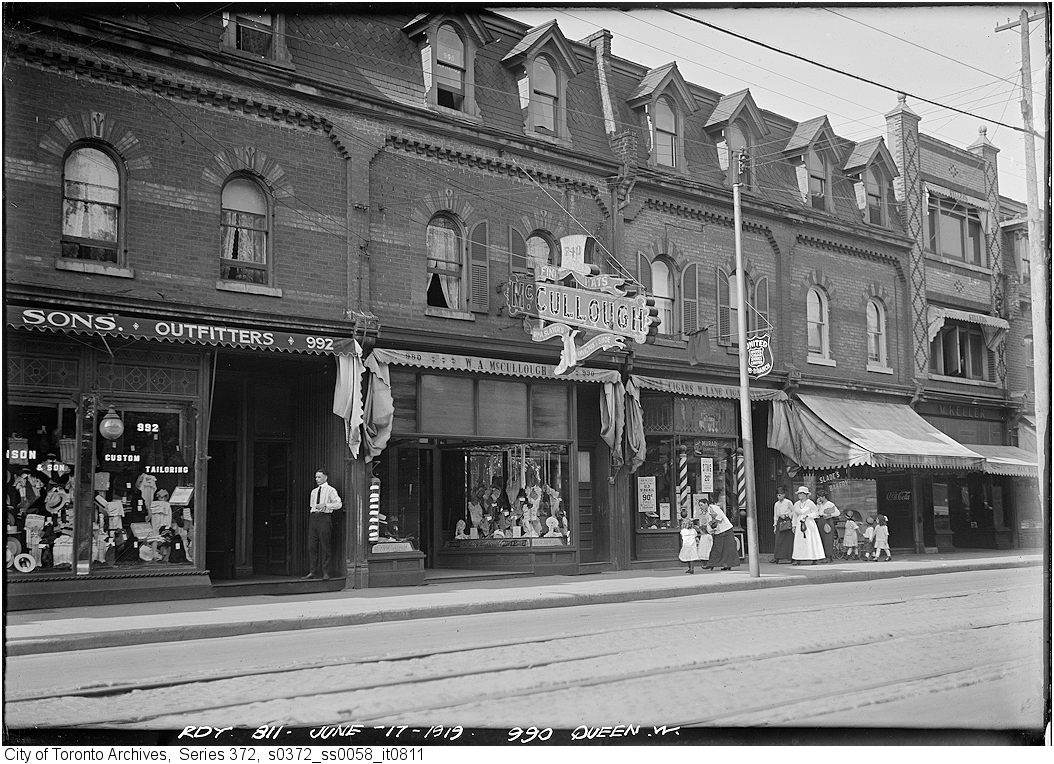
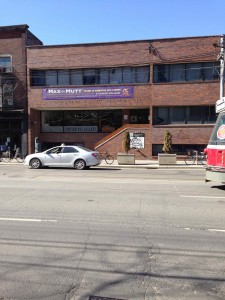
Wu Chong was a tenant at 956 Queen St. West, owned by James Hunter, and operated a laundry mat from that location. According to the Toronto Street Directories, the property was listed under Sells H & Sons, assumed to be Hunter & Sons, in 1889 and “Wer. Chong” became a tenant in 1890. The name “Wer. Chong” may be an interpretation of his name by the person filling out the assessment. According to the Assessment Roll of 1900 and Valerie Mah’s “The Bachelor Society”, there is only one person listed under this address, meaning that Wu Chong was either a bachelor or working and sending money home to his family in China. It can be confirmed that Chong operated from that establishment from 1890-1917. However, beginning in 1917, the establishment is listed in the Toronto Directory as “Chinese Laundry”, which may have still been operated by Chong. The property is located across from what was then known as the Provincial Lunatic Asylum (known today as the Centre of Addiction and Mental Health (CAMH)). The appearance of the shop can be assumed to be similar to the properties shown in the photo above of 990 Queen St West in June of 1919. The location is currently occupied by the Museum of Contemporary Canadian Art (MOCCA) and will be replaced by condominiums as part of a redevelopment plan.
Works Cited:
Assessment Roll (1900) Ward 5 Division 1; City of Toronto Archives.
Mah, Valerie. The bachelor society: a look at Toronto’s early Chinese community from 1878-1924. MA Thesis. 1978. Print.
Provincial Lunatic Asylum (June 1973). Public Works Photographs. Series 372, Item 69. City of Toronto Archives.
Toronto Directory (1889-1917); City of Toronto Archives.
990 Queen St W (June 17, 1919). Public Works Photographs. Series 372, Item 811. City of Toronto Archives.
/wp-content/uploads/2013/04/countercultureslogopart3-300x106.png00steven.dasilva/wp-content/uploads/2013/04/countercultureslogopart3-300x106.pngsteven.dasilva2014-04-14 17:49:362014-04-14 21:43:26The Chinese in Early 20th Century Toronto: 956 Queen Street West
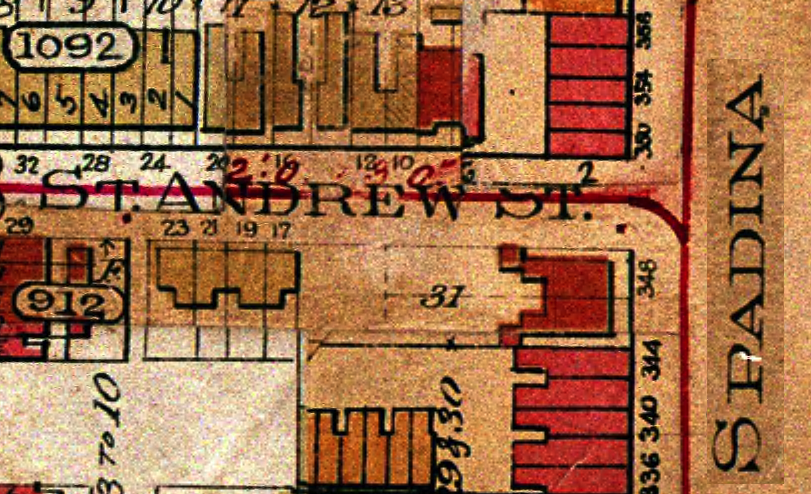
352 Spadina Ave. in 1903 Map: Clip from Plate 23 of Goads Fire Insurance Plans
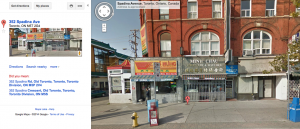
352 Spadina Ave. in 2014 Google Maps
In accordance with Valerie Mah’s research, the City of Toronto Directories from 1900 and the Tax Assessment Rolls from 1901 do verify that, at that time, 352 Spadina Ave. was occupied by a person by the name of Mah Tang.
Valerie Mah’s research (in her thesis The Bachelor Society A Look at Toronto’s Early Chinese Community 1878-1924), which included a letter from Thomas Humprhies to Reverand MacKay, listed 95 Chinese establishments in Toronto on July 25 1900. That letter stated that 352 Spadina Ave. was occupied by Mah Tang and 3 other Chinese people.
The Tax Assessment records from 1901 state that Mah Tang was a tenant of Thomas Hook. His occupation is listed as “laundry.” Mah Tang’s business must have run out of the street-level portion of the building, because there is tax listing for another tenant that lived “over 352” named Patterson John J. (This upstairs tenant was recorded as 44 years old, with 6 family members, 3 children. The owner of the upstairs property was Edward Leadlay). Mah Tang was recorded to have 2 “Persons in Family” and no children.
According to Goads Fire Insurance Plans from 1903 (image attached), this building was located at the North-Western corner of the intersection of Spadina Ave. and St. Andrew St. In these plans, the building is coloured red, which indicates that it was a brick building.
Today that building bears the same address and is home to Minh Cau Jewellers who sell jewellery, watches and optical glasses (storefront image attached). Their website can be seen here: http://www.minhchau.ca/
___________________________
WORKS CITED
City of Toronto. Tax Assessment Rolls. Ward 4 Division 3 (1901). Reel 148, Location 264736:40. Microfilm. Pg. 50.
City of Toronto. Directories (1900). Reel 46. Microfilm. Pg. 233.
Mah, Valerie. The Bachelor Society: A Look at Toronto’s Early Chinese Community from 1878-1924. MA Thesis. 1978. Print.
Letter from Humprhies to Rev. MacKay, July 25, 1900, File 33, Box 1, United Church Archives, as noted in Mah 19.
/wp-content/uploads/2013/04/countercultureslogopart3-300x106.png00Elyse Lue-Mayo/wp-content/uploads/2013/04/countercultureslogopart3-300x106.pngElyse Lue-Mayo2014-04-14 17:42:402014-04-14 21:43:48The Chinese in Early 20th Century Toronto: 352 Spadina Ave., Toronto, Ontario, Canada
According to the City of Toronto Directories, the first building constructed on the site of 460 Spadina must have been established around 1888. This seems to be the case because, in 1887, lots 365 – 497 where College St. intersects were listed as: “stables, house, private grounds, Methodist Church, vacant lot, unfinished house, vacant, vacant, vacant lot.” In the City Directories for 1888, lot 460 is listed under “White Alfred.” Alfred White was the registered in the City of Toronto Tax Assessment Rolls for St. Patrick’s Ward in 1888: aged 42, occupation was “gents furnishing” with 7 family members. The size of the lot of land was 234 x 188 and on that lot was a brick building sized 18 x 266 / 14 x 31.
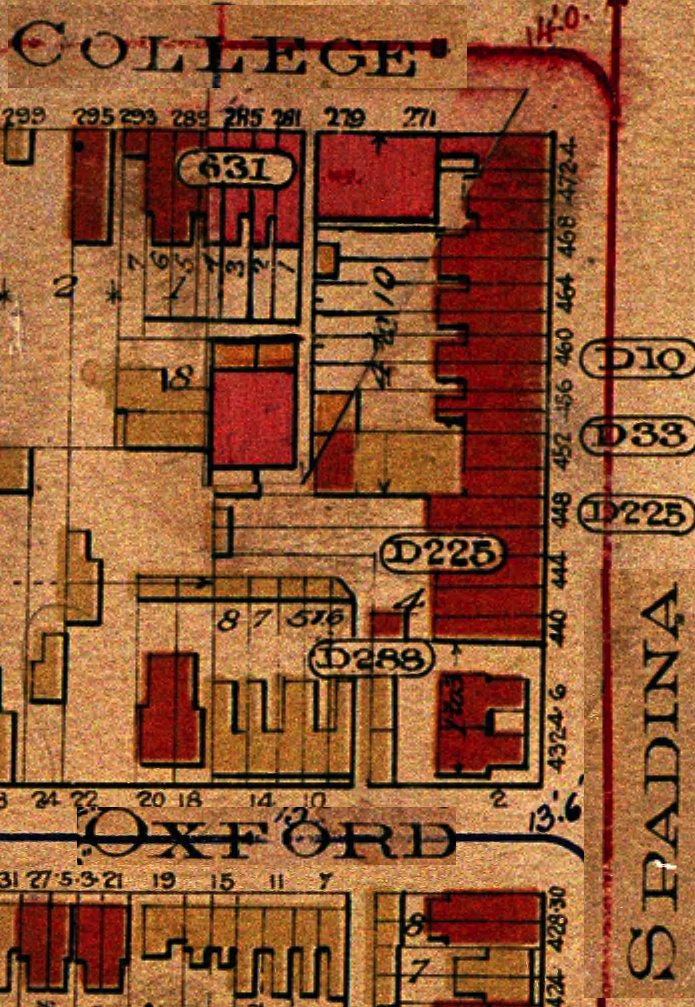
Map c. 1903: Clip from Plate 23 of Goads Fire Insurance Plans
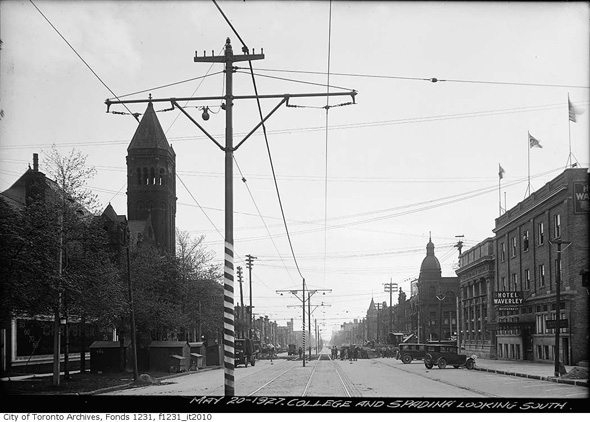
c. 1927 on Spadina Ave., looking south to College St.
According to Goads Fire Insurance Plans from 1903 (above), this building was located at the South-Western corner of the intersection of Spadina Ave. and College St. In these plans, the building is coloured red, which indicates that it was, indeed, a brick building. The photo (above) shows what the intersection looked like during the late 1920’s.
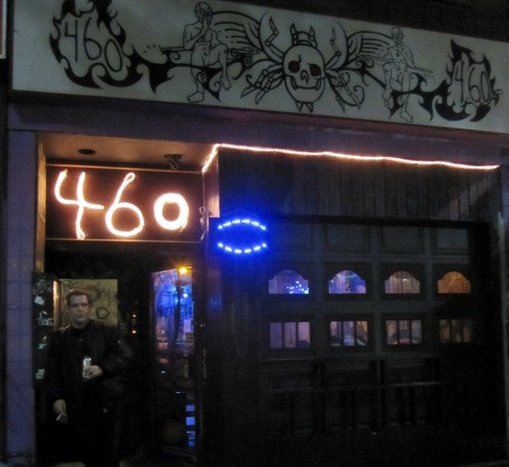
Today: Outside the 460 Bistro Bar (c. 2012).
Today: Inside the 460 Bistro Bar with Mona behind the cashier (c. 2012).
Today that building bears the same address and is home to The 460 Bistro Bar. The woman who runs the business is named Mona and she moved from Southern China under a decade ago. Her bar has become somewhat of a legend among Toronto’s underground art and music scene.
c. 1990s: Just north of 460 Spadina Ave. is the El Mocombo (464 Spadina Ave.)
Mona recalls that the previous business owner of 460 Spadina was a Vietnamese man named John. The City of Toronto Directories for 2001 do in fact list “John’s Restaurant” at that address.
Mona also recalls that before John, two Chinese women named Nancy and Michelle ran a restaurant and bar that served breakfast, lunch and dinner – apparently it was quite popular among University of Toronto students. The City of Toronto Directories for 1980 and 1990 simply list “Coffee Shop.”
_____________________________
CITATIONS
City of Toronto. Tax Assessment Rolls. St. Patrick’s Ward (1888). Microfilm. Pg. 81.
City of Toronto. Directories (1887). Microfilm. Pg. 213-214.
City of Toronto. Directories (1888). Microfilm. Pg. 248.
City of Toronto. Directories (1955). Microfilm.
City of Toronto. Directories (1980). Microfilm. Pg. 783.
City of Toronto. Directories (1990). Microfilm. Pg. 445.
The address I chose to do was 84 Ulster street. Mainly because I have never heard that street name before and I figured it would be fun to figure out the history of it. It was a thrilling experience until I realized I would have to scroll through many pages of film to get to the name listed at the address. When I first started to look for the address in the fire plans I found that 84 Ulster street was in Ward 4 division 2. After figuring out the ward went into the roll of 1899, and decided to see who lived there at the time and what occupation they may have had. Then I stumbled onto this: 84 Ulster Street was the location of a laundry owned by Bing Lee. The laundry was named Peoples Loan Company. By 1903, 84 Ulster, also a laundry, was owned by a Lem, Yong.
Works Cited:
Assessment Roll: Ward 4 Division 2 1899
Assessment Roll: Ward 4 Division 2 1903
/wp-content/uploads/2013/04/countercultureslogopart3-300x106.png00saviochazhoor1/wp-content/uploads/2013/04/countercultureslogopart3-300x106.pngsaviochazhoor12014-04-14 17:38:382014-04-14 21:44:55The Chinese in Early 20th Century Toronto: 84 Ulster Street
According to Valeria Mah’s thesis paper The Bachelor Society, 309 College Street in the early 1900s was occupied by a Chinese bachelor named Charlie Lung. However according to information gathered from the 1899 and 1903 Goad’s Fire Insurance Plans, the 1900 and 1901 Toronto City Directories and the Toronto Assessment Rolls there was no one living at that address. In fact, there was no building at 309 College Street. It was an empty lot according to the Goad Insurance Maps with no structures.
Despite this anomaly, Charlie Lung does appear in the City Directories of 1900 and 1901 however he is listed at 697 Yonge Street not 309 College. This could mean that there were more than one Charlie Lung’s in Toronto. The 1898 Assessment Roll has no listing for 309 College Street but there is a Charlie Lung listed at 313 College Street. According to the information, Lung ran a laundry, was the householder, and lived alone. There were no other listed tenants or family members. The building itself was owned by Florence (last name is illegible) from Montreal.
However in the 1901 Assessment Roll, Charlie Lung is listed at 313A College Street owned by Gordon Jones. He still ran a laundry business and was a householder. This might be explained by the rapid growth of the city which altered street numbers. It is not likely that Charlie Lung moved his laundry down one house between 1898 and 1901 therefore it is probable that it was the street numbers that altered.
In both Assessment Rolls, Lung’s religion is listed as Chinese. This listing of Lung’s ethnic and racial background as a religion highlights the ‘othering’ of the Chinese in Toronto at the time and the ignorance of Chinese culture.
Works Cited
Assessment Roll (1898): Ward 4 Division 2; City of Toronto Archives.
Assessment Roll (1901): Ward 4 Division 2; City of Toronto Archives.
Goad’s Fire Insurance Map (1899 & 1903); City of Toronto Archives Website.
Mah, Valerie. The “Bachelor” Society. A Look at Toronto’s Early Chinese Community from 1878 – 1924 (unpublished, 1978).
Toronto City Directory, 1900 & 1901; City of Toronto Archives.
/wp-content/uploads/2013/04/countercultureslogopart3-300x106.png00Akayla Onabowale/wp-content/uploads/2013/04/countercultureslogopart3-300x106.pngAkayla Onabowale2014-04-12 03:19:092014-04-14 21:45:44The Chinese in Early 20th Century Toronto: 309 College Street